Game Lore Translation
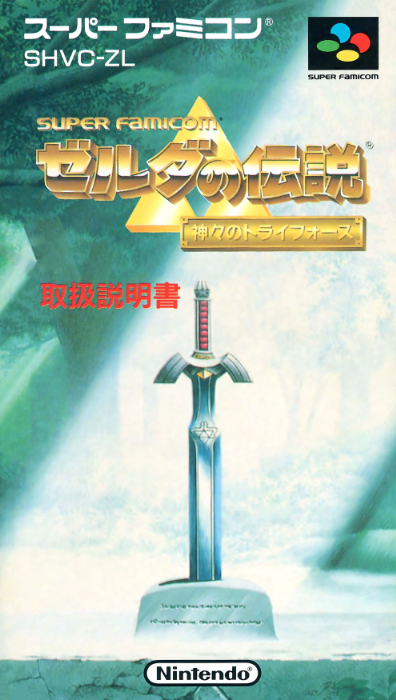
An ambitious instruction booklet
The game's true lore begins right from the manual. This is largely unknown to many people, but the genesis of the world of Hyrule was already recounted in A Link to the Past, in its manual, years before Ocarina of Time's Great Deku Tree. The only element the latter adds is a proper name for each Goddess, but otherwise everything was already there. Thus, the first few pages of the manual recount the legend of Hyrule.
The lore was written by Yoshiaki Koizumi (小泉 歓晃), who is credited in the "Printed art work" section of the end credits. According to what is widely heard on the Internet (I have not verified it myself), Miyamoto did not particularly want a convoluted story for his Zelda 3 and wanted to keep things simple, in the vein of the first two Zelda games, but Koizumi aspired to something grander and therefore wrote these 7 introductory pages at the beginning of the manual. These would also have influenced the development of the game, which indeed features a relatively verbose introduction sequence that distills story elements through its many NPCs.
Game Synopsis
"Yeah, if I want the synopsis, I'll just read the manual..."
Not so fast! The texts below are not merely a paraphrase of what is written in the English game manual. On the contrary, they are a precise, annotated translation of the original Japanese manual. Indeed, the English manual — and the French manual based on it — are riddled with translation mistakes, approximations, and additions of information that did not exist in the original text.
Through my thorough reading and in-depth analysis of the original, combined with my knowledge of the game and the series as a whole, I took the time to come up with the translation below, while leaving extensive notes on untranslatable subtleties of the Japanese language that add context.
So, even if the translation below is more literal than stylized, I correct all the mistakes found in the official translations, and I am proud to present to you the synopsis of A Link to the Past, and more broadly the founding text of the Zelda series lore, in a version you have never seen before, as faithful as possible to its author's 1991 vision.
Story: "The History of Hyrule"
To speak of Hyrule, the setting of The Legend of Zelda, one must first touch upon the myth of the Triforce. It is an ancient mythology that persists in Hyrule concerning a tritheistic cult. Long ago, the Hylians (who are also the origin of the word "Hyrule"), the people closest to the divine beings, left writings to their descendants in Hyrule describing the creation of the world by three deities: the "Goddess of Power", the "Goddess of Wisdom," and the "Goddess of Courage."
I must admit I am not entirely sure whether it is "the tritheistic cult" or "the ancient mythology" that persists in Hyrule. I chose the latter because it seemed more logical grammatically, but both interpretations make sense.
Mythology
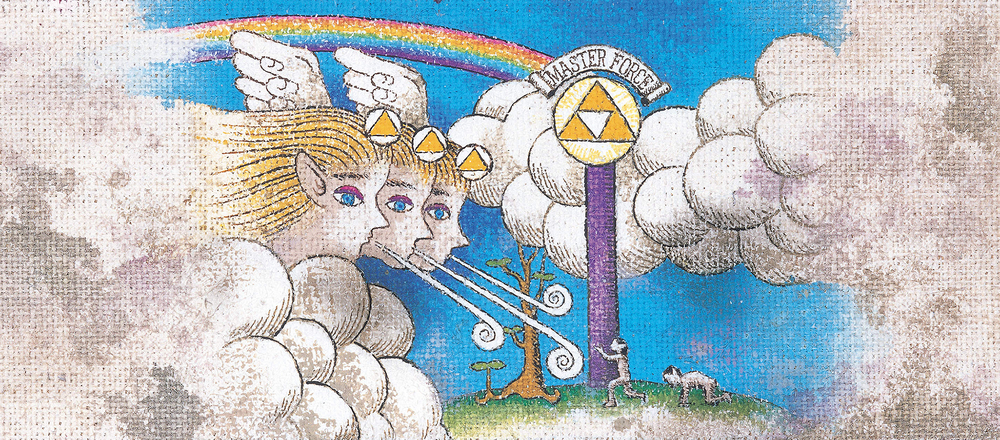
Long before humanity appeared, in an age when the world was nothing but a mass of chaotic void, the Goddesses descended upon it and, each wielding her own power, brought order and life to it. The "Goddess of Power" dyed the mountains red with fire and shaped the earth. The "Goddess of Wisdom" created science and magic, and brought order to nature. Finally, the "Goddess of Courage," from her good and vigorous heart, created all living beings, from those that crawl upon the ground to those that soar through the sky. Their work complete, the Goddesses, upon departing this world, left behind the "Triforce," a holy golden triangular body that symbolizes their power, and entrusted it with the destiny of the entire world.
Still according to these writings, the Triforce is composed of three emblems: "One Who Dominates Power," "One Who Commands Wisdom," "One Who Disciplines Courage", and, awaiting the arrival of someone worthy of inheriting its power, it shines continuously in the Holy Land, located somewhere in the world.
The people of Hylia, who left behind these writings, were a chosen people who could hear the voice of the Gods. As such, in addition to their long ears, they possessed highly keen senses and wielded magic. Their descendants took root in every region, and it is said that they passed down their magic and their prophecies.
The Japanese term used for "Hylians" is ハイリア人 (Hairia-jin, literally "people of Hylia"). This term refers to this people close to divine beings with long ears (you can say "the Hylian race" if you prefer) and is often confused with "the inhabitants of Hyrule" (ハイラル人 - Hairaru-jin, literally "people of Hyrule"), even in the official game translations.
These divine beings, though not gendered in the text, are represented by feminine entities in one of the manual's illustrations. Apparently, the manual's translation was done without the images, as the English version refers to "gods."
"Power" is the term used in the official English manual, but in later entries in the series, other words have been used, most notably "Strength" or "Force." All of these translations stem from the same kanji, 力 (chikara), which has several meanings and therefore several possible translations. For this page, I chose to retain the term "Power" as it conveys something more abstract than "Strength," which implies brute physical force, while being more specific than a word like "Might."
I took some freedom with the translation of this expression, as the Japanese term used is おさめさせました (osamesasemashita), which, in a strictly literal translation, means "to let reign" or "to make reign." In English, for anyone familiar with the series' lore, this results in nonsense: the Triforce does not dictate the rules of the world, nor does it make decisions. We are dealing here with an abstract nuance you won't find in a dictionary, whereby the Triforce is "responsible" for the balance of the world — a kind of guarantor of the order of things. It is very subtle, and for these reasons I chose the expression "entrust with destiny" for this translation, even if it is less literal.
The three emblems are of course the three parts of the Triforce. In Japanese, the term used is 紋章 (monshô), and if you look it up in a dictionary, you will only find words like "crest" and "coat of arms", which concretely refer to the symbol of a royal family or something of that nature. However, just as with the term おさめさせました discussed earlier, it is used here in a more abstract sense, closer to the words "emblem" or "symbol" in English, which is why I chose the word "emblem" for this translation.
Each part of the Triforce is associated with a short descriptive phrase rather than a simple noun. Here is the original version if you are interested: 「力を支配する者」「知恵を司る者」「勇気を鍛える者」. It would be easy for someone with only a basic knowledge of Japanese to assume that the repeated term 者 refers in each phrase to the person who will be the bearer of that part of the Triforce, but that is not the case — the text is very clear, and it is indeed referring to each of the "emblems," each small triangle that makes up the Triforce. To my knowledge, this is the only place in the series where these expressions are used, as they would later be replaced starting with Ocarina of Time by the much simpler terms "Triforce of Power," "Triforce of Wisdom," and "Triforce of Courage." Personally, I find the A Link to the Past expressions to have more style — though that is probably my inner fanboy talking 😁.
For this translation, I chose to use the term "Holy Land." "Sacred Land" would also have worked, but I preferred "Holy" as it carries a nuance of something closer to the divine, while "Sacred" tends to be defined in relation to an object of veneration, as opposed to the "profane" — though this is a minor distinction. The original term is 聖地 (seichi), making my translation a literal one. The official translation (both in the manual and in-game) is "Golden Land," even though there is no notion of gold in the Japanese name. That said, since the Triforce is explicitly an artifact made of gold, I find this choice of expression particularly appropriate. Later in the series, the term "Golden Land" would be replaced by "Sacred Realm" in the English versions.
The Holy Land
Hyrule is a land closely tied to mythology, within which still lie many remains left by the Hylians. It is also here that an old legend surrounding the Triforce is passed down:
Descended from the heavens, a golden power resides somewhere.
The hopes of the first to touch it shall reach the gods.
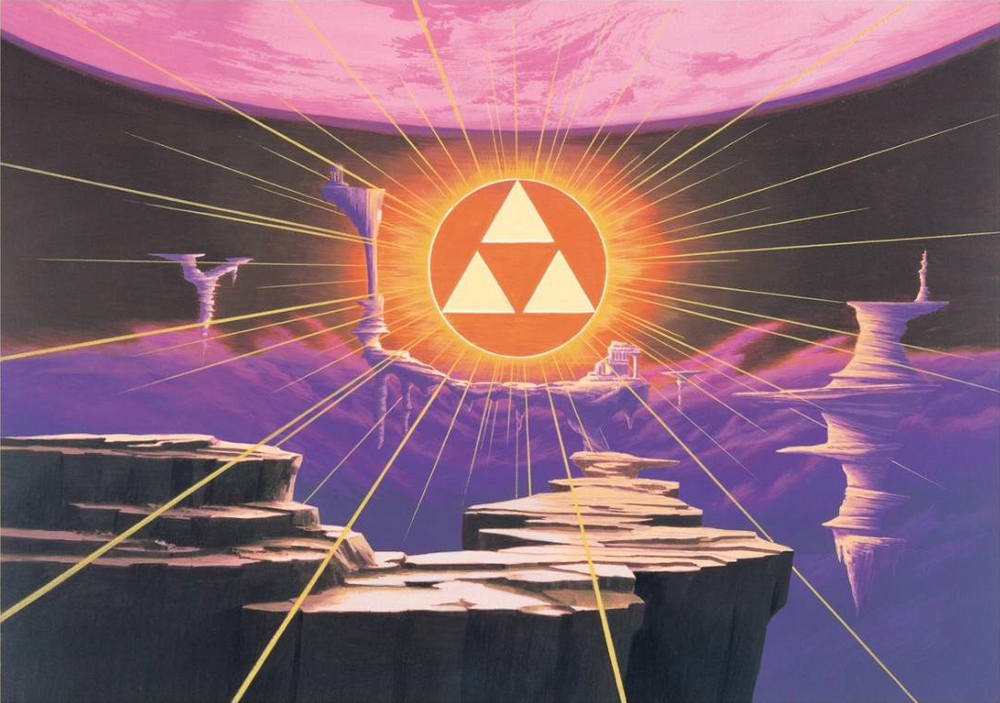
People, greedy for this golden power, began searching for the Holy Land with the goal of being the first to discover it. Information circulated from all sides: it was said to lie beneath the ruins of the desert, or inside the tombs of the high mountains peoples; yet there was still no trace of any discovery. As aspiration turned to desire, much blood was shed over this information. Peaceful folk were forced to live through threatening times. Then one day, perhaps entirely by chance, the entrance to the Holy Land was opened by a group of bandits.
I translated the following Japanese term as "high mountains peoples": 高山民族 (kouzan minzoku). First of all, it is difficult to tell whether it is singular or plural, but the context led me to prefer the latter as it felt more natural given the enumeration — there is no particular emphasis on one or the other. The term 民族 (minzoku) can be translated as "people" but also "race" or "ethnic group." 高山 (kouzan), for its part, is simpler — it is the combination of "high" and "mountain," so "high mountain" 😅. The only non-enemy in-game character who could match this description is the old man in his cave on Death Mountain, even though no tomb is found there.
In the Japanese manual, the term used is 盗賊団 (touzokudan). If you simply look it up in a dictionary, you will likely find the word 盗賊 (touzoku) translated as "thief," but in reality it refers to something closer to a "bandit" or "brigand," with that outlaw quality of someone who attacks the weak by the roadside. This is why I preferred the term "group of bandits" over the "gang of thieves" found in the official translation.
This place was a world unlike the one they had come from. At the heart of the twilight, the Triforce shone golden. It is said that the bandits shoved their companions aside, the colour of their eyes changed, and all rushed toward it. At the end of this bloody rift, only the leader of the bandits survived. The moment he touched the Triforce with his hands still stained with fresh blood, the spirit of the artifact whispered to him:
Whatever it is you desire, then I too desire it.
Transcending space and time, it is said that the bandit leader's roaring laughter echoed all the way to far-off Hyrule. The man's name was Ganondorf, and he went by "Ganon the Evil Bandit". That precise moment marked the birth of the one who would threaten Hyrule, Ganon the King of Evil.
My translation is literal; here is the original version if you are interested: 「汝、望むもの有らば、我もまた、それを望む。」 The meaning is obviously something along the lines of "Whatever you desire, I shall grant it," but I wanted to highlight the fact that the Triforce expresses that it too "desires" what the one who touches it desires.
The surname "Dragmire," as well as the nickname "Mandrag Ganon" and its supposed translation "Ganon of the Enchanted Thieves," are additions from the North American version of the ALTTP manual. In the original Japanese manual, he is given a name: ガノンドロフ, Ganondorf, with no surname, and this nickname: 魔盗賊ガノン. I translated the latter as "Ganon the Evil Bandit"; I won't revisit the term "bandit," whose explanation can be found in the previous note. As for "evil," it comes from the kanji 魔, which gave rise to the word "Enchanted" in the official translation. However, it carries a strong negative connotation and is used primarily in words such as "devil" or "witch," which is why I preferred the translation "evil."
A third name for Ganon is used in the Japanese manual but absent from the Western manuals: 邪悪の王ガノン. My translation is fairly literal, but throughout the series other names derived from the same expression have been used, such as "Demon King."
The Seal War
No one knows what Ganon, having obtained the power of the Triforce, wished for. However, Ganon's evil aura swept all the way to the land of Hyrule. The most greedy of people were drawn in by this power and vanished. Black clouds permanently covered the sky, and sinister incidents struck Hyrule one after another. The King of Hyrule then called upon the Seven Sages who lived in Hyrule as well as the guild of knights, and ordered them to seal away the source of evil.
The official translation uses the first person at this point, which gives the narrator a personal voice. In Japanese, it is possible to construct sentences with a verb but no subject, which is the case here in the original version. The narrator is impersonal, hence my translation as "No one knows."
The term used in the Japanese manual here is 邪気 (jaki), which has no direct equivalent in English, but "evil aura" comes very close to the idea. Think of it as a kind of "spiritual evil," with the image of a malevolent wind blowing towards Hyrule.
There is a nuance here that I was unable to fully express in English, and so I had to make a choice. In Japanese, the text refers to ハイラルに住む七人の賢者達, meaning "seven sages who lived in Hyrule." I translated this as "the Seven Sages who lived in Hyrule." The nuance lies in the fact that "the" seven sages implies there are exactly seven sages in total, and no more. But another interpretation could just as well be "seven people among the sages living in Hyrule" (implying there are more than 7 sages, but the King of Hyrule only called seven of them). Both interpretations are equally valid, and it is primarily my knowledge of the rest of the series that guided this choice in this translation.
What I refer to here as the "guild of knights" is called the "Knights of Hyrule" in the official English translation. In truth it is nearly the same thing; the only nuance is that the term 騎士団 (kishidan) used in the original is a common noun and not a proper noun, hence the absence of capitalisation in my translation (because yes, I even deliberated over capitalisation for this translation if you want to know everything 😁).
The Triforce does not distinguish good from evil on its own, for the simple reason that only the Goddesses distinguish good from evil. That being said, whoever takes possession of the Triforce is not necessarily a good person. That is why the people of Hyrule, following a divine message, forged the sword that eradicates evil, which repels the evil taking hold of the Triforce. This sword is known as the Master Sword, and it was said that only a true hero could wield it.
I translated this as "the people of Hyrule" rather than "the Hylians" because that is exactly the term used in Japanese: ハイラル人 (hairaru-jin) and not ハイリア人 (hairia-jin).
Regarding "who" forged the sword and "when," the official English translation got completely tangled up at this point, which is understandable given the placement of this paragraph! The creation of the Master Sword recounted here is an ancient tale, and "the people of Hyrule" are not the inhabitants of the current land under attack by Ganon, but older entities. The Master Sword was therefore not created in response to Ganon's evil aura at that moment, nor was its forging ordered by the King of Hyrule mentioned in the manual. This goes back to far more ancient times, as evidenced by what comes after, which mentions that the Sages set out to search for the sword; had it been created at that time, there would have been no need to go looking for it!
What I translated as "the sword that eradicates evil" comes from the Japanese expression 退魔の剣 (taima no ken), regularly used in the series to characterize the Master Sword. In English, several translations have been seen across the games, such as "blade of evil's bane" appearing in this very official translation) or "sword that seals the darkness".
"Master Sword" is an English term, but in the Japanese version it is that same term, written in katakana: マスターソード. The French version took a bold liberty that was repeated in other entries in the series such as The Wind Waker, by naming it "Excalibur."
The Seven Sages first began searching for the Master Sword as well as the hero who could wield it. However, Ganon's evil aura rapidly approached the royal palace, making the situation critical. The Sages and the guild of knights, pushing their strength to the limit, fought a fierce battle against the villains. The guild of knights, acting as shields absorbing the violent attacks, unfortunately reached the limit of their strength and some lost their lives, but the Sages' seal was completed. Hyrule was protected from Ganon's abuse of the Triforce's power, and rejoiced in the victory that allowed peace to be preserved. This battle, which claimed many lives, was passed down to posterity as the "Seal War".
The Japanese term here is 悪しき者, a combination of 悪しき (evil) and 者 (individual, which does not refer exclusively to humans, as we saw with the Triforce earlier). Since Japanese has no plural form, this 悪しき者 could be translated as "the villains" in the sense of "Ganon's minions", or be singular, which could refer to Ganon himself. However, in-game, the Swamp Palace's maiden tells us that Ganon was unable to return to the Light World, which rules out this possibility. The nature of these "villains" is not specified, even though it is easy to imagine they are the greedy people drawn in by Ganon's evil aura mentioned earlier. But I'll leave that for you to theorize about!
If you rely solely on the original text of the manual, it is impossible to know whether all of the guild of knights lost their lives, or whether there were survivors. The answer is given to us in-game by Thieves Town's maiden, who specifies that the line of knights has almost died out, hence my translation choice here.
The Japanese term for the Imprisoning War is 「封印戦争」, which translates to "Seal War". While not incorrect given the context, "Imprisoning War" carries a slightly different nuance that was not present in the original text.
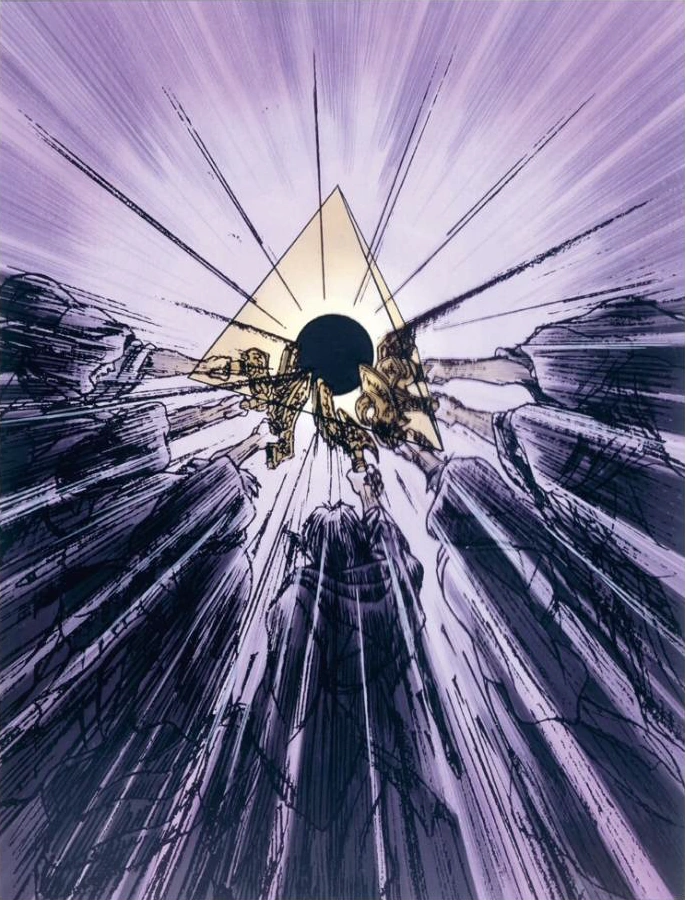
The Priest
Several centuries had passed since the Seal War. Hyrule, owing to the wisdom and piety of its people's hearts, was at peace. All that pertained to the Seal had by then become a distant legend passed down through stories. However, there came a year in which calamities of unknown origin struck. Epidemic, drought — the power of magic could do nothing. The King of Hyrule, completely helpless, had the Seal inspected, but it changed nothing, and the people had no choice but to pray to the goddesses.
It was then that a man appeared out of nowhere, Agunimu, who, using a strange magic, calmed the calamities. The people hailed him as a hero, and the king, seeing in him something like the return of the Seven Sages, invited him to the castle as a priest. Peace had returned to Hyrule, or so it seemed. However, Agunimu, who had been entrusted with the governance of the land, began to rule over Hyrule in the king's place, and started using that authority as he saw fit. Of late, negative rumours would not cease: "He intends to push the king aside and claim the throne for himself," and "He performs suspicious rituals every night." Hyrule entered an era of new tensions.
In Japanese, the expression used here is 彗星のごとく現れた, which literally means "appeared like a comet." This expression carries the nuance of appearing suddenly, extremely quickly, without anyone seeing it coming — "as fast as a comet." Unfortunately I could not find an English expression that conveys an equivalent meaning, so I settled for "appeared out of nowhere."
Since this translation aims to be very literal, I chose to use the proper name "Agunimu," which is the transcription of his Japanese name written in katakana (アグニム). I found no hidden meaning or wordplay unique to his original name, which leads me to say that the name "Agahnim" is not a problem — it is simply a personal choice here.
In the English version, Agahnim is described as a "wizard," a term never used in the original. This is a case of censorship; I refer you to my paragraph on censorship for more details.
In this part of the text, it is clear that it is the king who bestows the title of "priest," and that Agahnim did not proclaim himself as such.
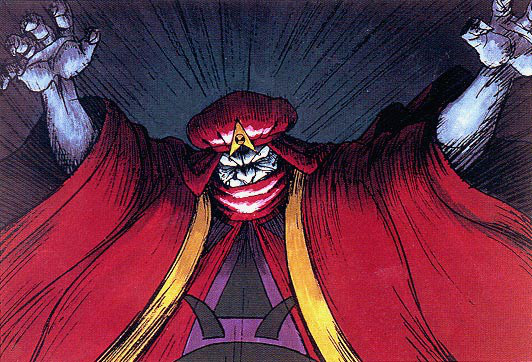
Prologue
One night, the voice of a young girl wakes you. The voice speaks to you inside your head:
Help me... My name is Zelda... I am being held captive in the castle dungeon.
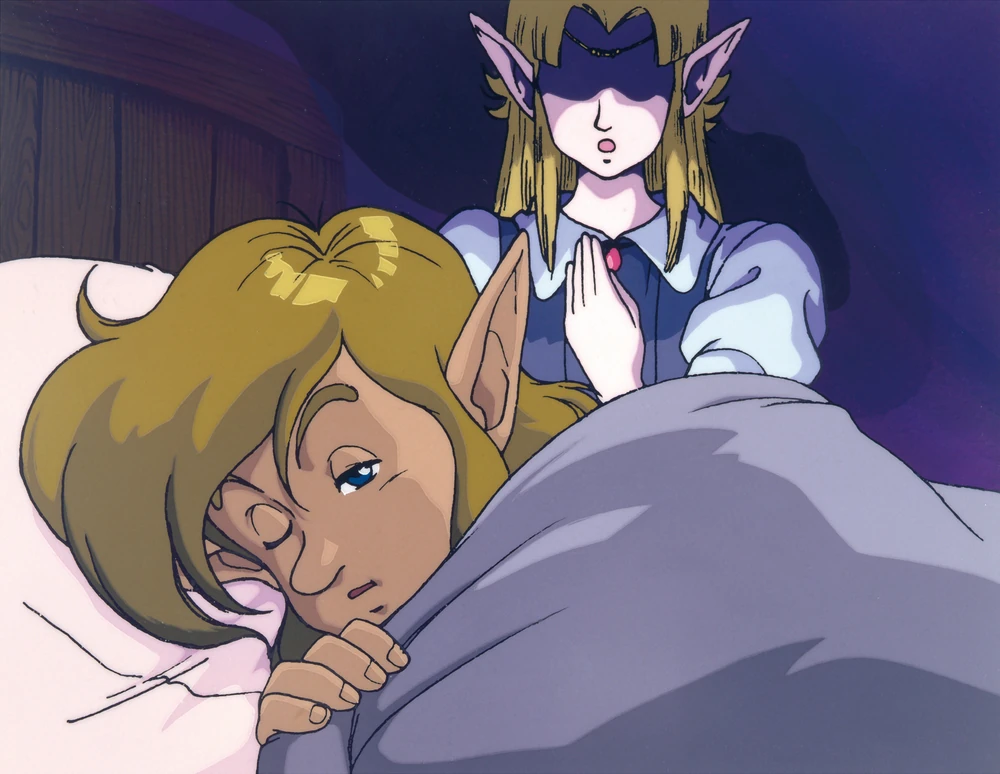
Not quite sure whether it is a dream or reality, you jump up to your feet. As you do, your uncle, who should be asleep as always, is preparing to head out. "I'll be back by morning — don't leave the house." Leaving those words, your uncle moved his large body and stepped outside. In the dim light, you caught a glimpse of a sword and shield in his hands. This is certainly not an ordinary night. What was that voice owner trying to communicate? And your uncle — where, and whatever could he have gone to do?
And so, it is on this ominous rainy night that the Legend of Zelda is about to begin.