The Legend of Zelda - A Link Between Worlds
On April 17, 2013, Nintendo — or more precisely Satoru Shibata — revealed a sort of spiritual sequel to ALTTP, whose name was only announced at E3 of the same year, held on June 11. The game returns to the ALTTP universe, with exactly the same overworld map, but with different dungeons and a new storyline. While the game goes back to basics with a top-down gameplay style, it is entirely rendered in 3D, and thanks to the 3DS' power compared to the SNES, it features richer colors.
The game is named A Link Between Worlds in the West, and 神々のトライフォース2 (Kamigami no Triforce 2) in Japan, clearly showing that it was designed as the direct sequel to the 1991 installment. I won't repeat the explanation of the Japanese title here — I already did so in the introduction of the index page of the ALTTP section, which I invite you to read if you haven't yet. As for the Western title, this time it is much easier to understand than its predecessor, since Link once again travels between two worlds in this game.
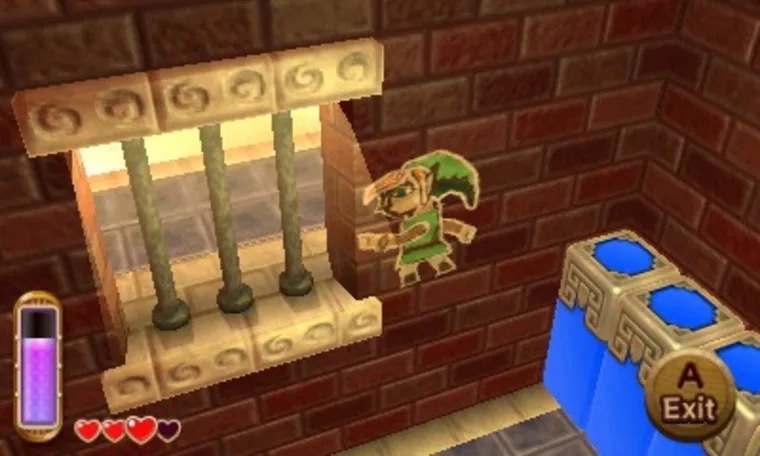
The main gameplay mechanic of the game is the ability to transform into a wall painting in order to move "inside" walls. Thanks to the 3D engine, you can switch from the interior of a dungeon room to the exterior facade of the building, and vice-versa. This idea offers many possibilities and is very well used throughout the game, whether in dungeon puzzles, in accessing various caves in the overworld, and the reused ALTTP world does not feel like a simple copy — the level design and 3D engine refresh it effectively.
The Light World / Dark World duality present in A Link to the Past returns in A Link Between Worlds, this time with the Hyrule / Lorule duality (a pun on "High"-rule and "Low"-rule). Both worlds are heavily inspired by those of ALTTP, with some additions — for example, the Dark World equivalent, Lorule, is ruled by its own sovereign, Hilda, whose name resembles Zelda. There are also 7 dungeons and the same non-linearity that characterized ALTTP's design. This time they are not even numbered, encouraging the player to complete them in the order they choose.
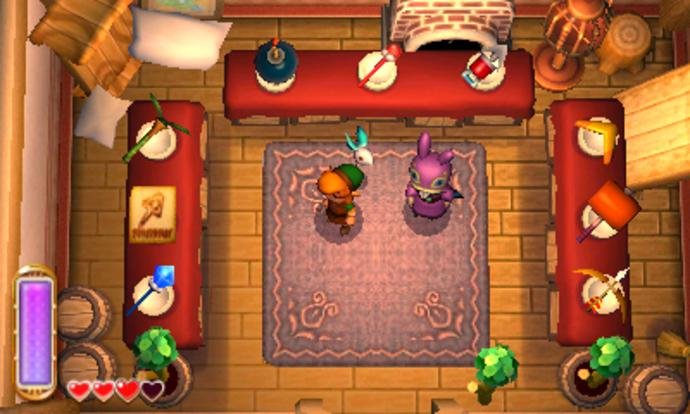
Another mechanic that begins the idea of "breaking the conventions of the series" — a concept dear to Aonuma after the release of Skyward Sword, and which would be emphasized even more in Breath of the Wild in 2017 — is making almost all items in the game available early on through a rental system, inexpensive at first, and later purchasable. The difference is that rented items are lost upon game over and returned to Lavio, the NPC who sells them, and must be rented again to reappear in Link's inventory. Conversely, purchased items remain permanently, even after a game over.
I could continue and give you a full presentation of the game, but I'll do better! Shortly after its release, I spent an entire day writing down my thoughts on the game, which I had just completed 100%, in a post on Le Palais de Zelda forum, still accessible today. It's one of my longest forum posts, if not THE longest — and I'm no stranger to long texts!The only thing : it's only in French. This is why I translated it fully in English so that I can share it to you below.
To keep this page from becoming too long, I arranged everything below in a collapsible section. Watch your scroll bar when you open it — it might be a little frightening!
Having finished the game 100% yesterday and explored nearly every corner (!), I think I know enough to give an opinion, even though, I must admit, I still lack full perspective. So this review is hot-off-the-press, very soon after completing the game. Warning: read only if you are far into the game or have completed it (at least the main quest). But I will tag all spoilers anyway, so if you want a general idea, don't worry ^^.
And of course, I don't know where to start. I'll give my general impression straight away: I loved this game. Fun fact: ALTTP is my favorite Zelda (I think many of you know that by now 😛), so a game that uses its universe hits hard for some, and for me, it hits times 10,000. I really enjoyed exploring every corner, seeing what changed from ALTTP, which I know by heart, and discovering new elements. The nostalgic and fan-service aspects are present, but well-balanced. I never felt overwhelmed. I won't say "ALBW is a must-have for the 3DS" or "worth buying the console for," because I lack the perspective to claim that.*ndlr1 Nevertheless, this entry is high quality, and in my personal Zelda ranking, it would rank quite high, higher than many Zelda games since OOT, just saying.
*ndlr1: I'm revisiting this text 10 years later, in 2023, so I think I have the needed perspective 😁. Nowadays the 3DS hasn't been sold for quite some time, so the question of whether it's a system seller is a bit outdated; retrospectively, I don't think so. That said, if you own a 3DS, it's definitely a must-have without any hesitation!
Now normally you might think I've lost it and this review is hot-off-the-press. Partly true, but mainly, ALBW borrows heavily from things I loved in ALTTP, not just the world, which I'll explain in more detail later.
Let's start with what I like to do in reviews: the beginning. At game launch, a drum roll followed by the amazing ALTTP title music remix is heard, the three Triforce pieces forming before our eyes like in the original, introducing a new twist: the completed Triforce casts a shadow, the "Dark Triforce" from the game's logo, and both move with a new musical variation leading to the title and an isometric view of the Hyrule Castle from the remake. The start of a new Zelda is always epic, and this thunderous introduction, far from the silent Skyward Sword title screen, brought a tear to my eye.
Anyway! I start the game, rename my character, and press A. Like in SS, we begin with a nightmare. Then Link sleeps in his bed, like in all "major" Zelda games since ALTTP. Then, like in TMC, a third party comes to wake us up. But it's not Zelda, it's Guly, a kid. First minor disappointment: the dialogues feel very childlike. I'll discuss the kid-friendly aspect later. Anyway, the kid wants me to go to dad, so I follow, accompanied by music worthy of B-movie American countryside (which I hate). Unlike ALTTP's dark stormy start, this is a different vibe, with only guards as NPCs blocking us!
From the start, we're confined to follow where the kid wants us to go: dad's forge. Turns out we're a blacksmith in this game, as in TMC. Interestingly, Nintendo seems to like giving Link a job early: in TMC, a blacksmith; in TP, a shepherd; in ST, a railway worker; in SS, a student at a knight school. Anyway, the guard captain just had his shield repaired and leaves satisfied, forgetting his sword. We can guess what happens next: we'll have to return the sword to him. Also, we expect a mishap and that we'll keep the sword :p. With the sword in hand, all game areas become accessible. Instead of heading to the castle as instructed, I first explored the whole region, from southeast to northwest and northeast to southwest.
Shortly after, a series of cutscenes plays, and then the game truly begins.
And from there, though I was a bit tired of the rather long start, I thoroughly enjoyed myself. Indeed, ALBW revives many classic ALTTP mechanics and proves they've aged well.
I'm particularly thinking of the very limited narration in the game, as in ALTTP. Back then, it was likely due to cartridge space limitations; they couldn't have a complete game and pace it with story sequences. Today, with current technology, it's possible. But Nintendo deliberately retained this minimal narration to immerse us further in the adventure and, above all, let us discover things ourselves. I appreciated that.
Similarly, in dungeons, when there's a puzzle, there's no helper like Fay, Navi, or Exelo, nor a camera movement indicating the solution. We are left to solve the puzzle entirely on our own.
In particular, and it's been a long time since I saw this: completely useless NPCs, yet with specific programming. I have three examples in mind:
- In the Milk Bar, there's a guy playing music for 10 rupees. Sure, it's not totally useless as it brings something, but still, it's curious—I don't recall seeing that in Zelda; more like Animal Crossing! Anyway, it's enjoyable, and I stopped several times in the tavern, leaving the 3DS as background sound, listening to some guitar and flute remixes :-).
- In the Lost Woods, the gossip guy. He's in a cave separate from the woods; his dialogues are long, we have a multiple-choice moment, and he says different things each time. But no matter how many dialogues we go through, we never gain anything more from him.
- In the same vein, in the Skull Woods, the same cave, but this time only reachable with the grapple hook (meaning you must fetch it again to access the cave!), hides a guy who can sell an item for 888 rupees. We decide whether to trust him and accept the offer. Of course, curiosity wins, and we end up with a rather useless "item" not worth 888 rupees, which can also be found elsewhere for free! After that, nothing more.
I could mention other mechanics, like knowing all dungeon locations on the map from the start, or being able to collect items anytime (I call it the "Ice Rod" syndrome from ALTTP: it's available early if you have bombs, even before the final Dark World dungeon—other items like Byrna's Rod or the Magic Cape follow the same principle). And of course, no one tells you where to get them, or even that they exist! Once again, it's up to you to discover everything on your own.
For example, I searched everywhere for the Pegasus Boots after finishing the game, and it was finally the last item I obtained in the whole game, even though you could have gotten it right after the first dungeon!
In short, many gameplay mechanics borrowed from ALTTP hit the mark for me, especially since they draw the player into the game rather than the opposite. This is something many older or newer Zelda games lack.
Regarding the pure gameplay, because that's what this is about, it is truly enjoyable, the very heart of the game, unlike a certain Twilight Princess (to name one) where the story takes priority. But this has a side effect on the story:
ALBW has almost no story.
I'll discuss that later.
So, the gameplay! Aonuma said he wanted to "rethink Zelda conventions." Big words, but the changes aren't huge; I'll explain why. The major changes and new features are as follows:
-
Paper Link. A great game element. From the trailers, I thought it would be limited, and indeed, it is in gameplay, but the locations where it's needed are well-designed. The main point of Paper Link isn't its gameplay but knowing when to use it. In some dungeon spots, I got stuck because I hadn't thought to use Paper Link on a wall corner. Also, many outdoor secrets require using Paper Link. Some are so well-hidden that you need it three screens away, and we'd never have thought to use it to reach that spot!
Furthermore, the concept of altitude has never been so important in a 2D Zelda. Often, Paper Link is used to reach a ledge further away, only to realize it's higher than expected. So you must find another spot to become Paper Link at a higher point to reach that platform.
However, while playing, I thought Paper Link could have been even better if they had leaned more on nostalgia. Paper Link has horizontal scrolling gameplay: it only moves left or right and can perform no other action. I thought of old Zelda II and wished for similar wall mechanics: jumping, sword strikes, and shield blocks. This way, we could fight enemies on walls and even learn new sword techniques like in Zelda II.
Nevertheless, Paper Link remains a very good invention, even if poorly justified story-wise. I'll revisit this when discussing the story.
-
Item rentals and being able to do dungeons in any order. These two elements go together, so I didn't separate them. In our house, which a character named Lavio turned into a shop, we can rent and buy all items in the game. In other words, we get spoiled on all items from the start. Some didn't like it, others tolerated it better. Personally, I liked this system, because there's a bonus Nintendo didn't mention: if we die, we lose all rented items. Also, rented items look ugly, with little bunny ears on them. Just that makes you want to buy the real item! Personally, I felt like a pro gamer and rented everything at once, which cost a few hundred rupees. You can imagine my disappointment when I faced my first game over :p.
So, since the items are available, we no longer have the classic Zelda pattern: "do a dungeon, get the dungeon item, use it for the rest, and defeat the boss." In fact, there are no more items in dungeons; the only chests contain the compass, the Big Key, and rupees.
Not entirely true: in the Dark World dungeons, there are still large chests, containing not inventory items, but pieces of equipment or pieces of the "Legend Rock."
So, when entering a dungeon, you don't know which items you'll need, so you might return home to rent missing items. This can be annoying if you've progressed far into the dungeon. Also, in many dungeons, there is still one essential main item needed to complete the dungeon and defeat the boss. So this doesn't change much compared to finding it in the dungeon.
For example, in my second playthrough, I completed the entire Wind Mansion using only the Wind Rod. Even though I could freeze flames and burning enemies with the Ice Rod, or fetch a distant key with the Boomerang in my first playthrough, I realized I could also perform these actions using only the Wind Rod.
That said, if you want to fully complete some dungeons or access certain chests, you'll need more than one item. But with money flowing abundantly in this game, you'll quickly acquire all items.
For me, it was around my 4th or 5th dungeon in the Dark World.
This means the further you progress, the less you fear a game over, since you keep all items you possess until the end of the game, even after dying. Also, you'll eventually have so much money that renting a 100-rupee item won't bother you at all.
In short, these two innovations don't fundamentally change how you play a 2D Zelda or Zelda in general. Nevertheless, they are pleasant and very well implemented.
Let's move on to the gameplay more generally. While there's innovation in how you get items, the items themselves aren't very innovative. Only two truly new items are in the game:
the Sand Rod and the Wind Rod. The Sand Rod is somewhat borrowed from Spirit Tracks, but worse, as in ST you could raise any patch of sand by touching it. ALBW isn't a touch game, so you don't have this feature. Nevertheless, using the Sand Rod in ALBW is well done and holds up compared to ST. The Wind Rod is genuinely new but very limited: you can only rise up, but cannot move. It's a bit like the Roc's Feather from LA/OOS, but less effective.
All other items are classic series staples, seen and revisited, which doesn't bring freshness to puzzles. But there's a cruel dilemma: remove even one, and fans get upset; keep them, and there's little room for new items…
One last note about item usage: Link is modeled in 3D and can move in more than 8 directions, but item handling is limited to 8 directions. So if an enemy is at a 30° angle, you must move to position them at 45° to use the corresponding attack. Nearly impossible in tight spaces. A small point that annoyed me; I think it wasn't very hard to program.
As for dungeon puzzles, not knowing which item to use when adds difficulty, especially since nothing is explained (no Fay around!) in the dungeons. I sometimes spent 15 to 30 minutes wandering around clueless.
I don't know about you, but I spent almost an hour in the Ice Ruins basement, thinking I was stuck! Likewise, in the Swamp Palace, it took me some time to realize you could move the rafts with the Grappling Hook. I even suspect—needs confirmation—that you can get stuck in this dungeon if keys aren't used in the right places…
Dungeons in general are very good, like in ALTTP: short but intense. Even if the first dungeons are easy and short, the following ones are trickier, with more complex puzzles and tougher enemies. A plus for ALBW not in ALTTP: every dungeon, except the first three, has its own music within a common theme. I really liked the atmosphere this gave each temple. Also, there are many dungeons—one less than ALTTP, but still more than most other Zeldas, which is notable.
I loved the atmosphere and puzzles of the Dark Palace. Having to turn off the lights to see better was simple, yet clever! Likewise, the music of the Swamp Palace hit the mark, as did Turtle Rock with its lava challenges, and the Bandit Village Palace with its excellent theme and design.
However, having many dungeons, and being able to do them in any order, directly impacts the story. In TP, ST, or SS, the story was rich, and dungeons had a pre-set order. In OOT, some dungeons could be done out of order: Fire and Water Temples, Shadow and Spirit Temples, the Well anytime after the Forest Temple… yet the story was still rich. I think this is the only game to strike a balance here.
ALTTP is like ALBW: you can do dungeons in any order, but there is very little narration. Back then, Nintendo found a workaround: much of ALTTP's story was in the manual, revealing things never told in the game! In ALBW, since there is no manual (except a simple digital one), this aspect is gone. So the story is only in the game, and apart from the dull intro, there's very little story. Don't expect big revelations or plot twists like in Twilight Princess—you won't get any.
In truth, there are only story moments at the very beginning and very end of the game.
Nonetheless, I really liked the only plot twist in the game: Hilda. She was presented as someone who would help in our quest, but she had been scheming all along. Even though she turns out good (everyone's nice except the villain), seeing her determined face with blazing red eyes did not leave me indifferent.
However, that's the only plot point I liked. Lorule seems to have a background at least as developed as Hyrule's, but it's too underdeveloped in the game. In my opinion, we may hear more about it in future installments.
And the part that annoyed me most is Lavio's Bracelet: this unknown character gives us an old smelly bracelet, Link puts it on, and it has a crazy magical power allowing escape from certain death, transforming into Paper Link, the major highlighted game element, ultimately saving Hyrule. The legitimate question: how did he get the bracelet? Is it linked to Yuga to break his spell? No answer is ever given. We just see Lavio is Link's alter ego, like Hilda is Zelda's, and nothing more. Lavio is a completely underutilized character—a real waste. Fun fact: Lavio looks a lot like a rabbit… a pink rabbit… Still don't see it? ;-)
And what about Yuga? Yuga, a Ghirahim copy, plays the role Agahnim had in ALTTP. Except he doesn't have a shred of Agahnim's style. Even Ghirahim has better justified motives, trying to revive his master. Yuga—what does he want? In the pre-final boss cutscene, it seems he wanted to help Hilda, which would have some credibility, but no: he's just a guy with no relation to Ganon, who wants to dominate the world because he's evil. That's it. Simply … terrible. There's no other word.
Regarding the semblance of a story in the game, namely the sages being kidnapped to resurrect Ganon, I think there's not much to say other than it's classic. At most, the only interest is the surprise of the seven Sages' identities, but you just need to see which characters stand out a bit more in the first part of the game (I wouldn't even say they are more "developed" than others), and there are your 7 candidates. By the way, there's a small inconsistency: seven Sages, and Zelda isn't one. Strange, since in previous games she was. And I doubt that Guly or Rosso, for instance, are of Hyrule's royal lineage.
Oh, by the way, I really liked being able to move around the Sages' Sanctuary and talk to all the Sages you've unlocked—it's nice :-)
Speaking of Zelda, she's completely useless throughout the game, appearing only three times in total; far from Spirit Tracks.
To summarize the spoiler above without spoiling, the semblance of a story in the game is rotten. But personally, that's not what I was looking for in the game, so it's not that serious.
In short, for those who haven't read (and I strongly advise against it if you haven't finished the game), I end my spoiler on a negative note and move on to a point that bothered me during the game: the childish aspect. We know Zelda is for all ages, young and old. But mostly young, in fact. That's what I think when I see the dialogues in this game, which are quite pathetic. At the start, it's a kid speaking, so that's forgivable, but later, even the characters are childish and completely clueless.*ndlr2
Only the characters from Lorule have a minimum of interest, and even then.
*ndlr2: I should clarify that at the time of writing this review I had only played the French version, and as I adapt it for the site I haven't played the original Japanese version yet, so I don't know how it really is.
The dialogues are childish, silly, and pathetic for most characters. The characters that annoyed me most are the Zoras. The Zora King in ALTTP had some presence, but here they are all dumb, even the queen admits it at one point. The scene that upset me the most is this one:
When you first go to Zora Village (which has only 4 inhabitants, by the way :p), and you see the queen fat. Everything in this scene is terrible. First, the music, worthy of the worst toddlers' cartoons. Then the sound effects, which make you uncomfortable. Then the only thing she does is eat a small fish. That makes her grow 10cm in radius. Then we are told about the "Super Soft Stone." THE SUPER SOFT STONE! Couldn't they have picked a less ridiculous name? I don't know the English translation, but I find it just pathetic: it feels like an episode of Dora the Explorer: "Find the Super Soft Stone! Come on, look with me!". In short, I have no words to express my dismay at this picturesque scene.
It's really a shame, because this childish aspect removes any possible depth from the Kingdom. In ALTTP, dialogues were a bit richer. Maybe it's my nostalgic side talking, but I find ALTTP's dialogues more "old-school," giving an ambiance and depth not found in ALBW.
Let's change the subject and tackle a sensitive topic: difficulty and game length. Difficulty is what clearly has been missing from Zelda since The Wind Waker (inclusive, I might add). That's been 10 years. Game length varied: for console Zelda, 20–30 hours straight to 40–50 hours for 100% completion, while portable Zelda games were around 15–20 hours with side quests, 25–30 hours for 100%. Being a portable Zelda, ALBW follows the rule. For me (because game length varies a lot by player), I finished the main story in 19–20 hours, and the 100% in just over 23 hours. All this while exploring a lot. I wouldn't say I "took my time," which to me means spending hours wandering everywhere and marveling at different locations. I explored a lot, but not to that extent: after all, I already knew the map.
Regarding difficulty, I was very satisfied: the beginning of the game isn't very hard, true, but from a certain point with my 6 poor hearts, I got shredded by the Hinox right away: touching them costs two hearts, their bombs one heart. Each enemy takes at least one heart, bosses 2–3 or more depending on the attack. I almost rejoiced seeing this :p. I had prayed to find the old-school difficulty I loved in ALTTP, and I wasn't disappointed. In ALTTP, entering the Dark World, enemies could deal 1–2 damage, just like here. Excellent. Even basic guards are technical to beat, as their sword range matches ours, requiring slight positioning tricks.
Well, until you get Excalibur, of course :p. But Dark World guards have the same range as Excalibur with their spears/pitchforks/swords, so it balances out!
For me, difficulty came more from combat than puzzles. In ALTTP, difficulty existed on both fronts. ALTTP is still harder, as from dungeon 5 enemies deal 4 damage without the blue tunic. In ALBW, as dungeons have no numbers, there's no set order, so they gave enemies a max of 2 hearts. Also, we no longer have the tricky rooms found in ALTTP around dungeons 6–7–Ganon's Tower: ruthless rooms with powerful enemies charging at you, sentinels firing at you, and tiles launching at full speed. Nonetheless, ALBW is still challenging, especially in platforming sections; it's just that you recover far more hearts than in ALTTP, making it easier. People are free not to take them, that's when you realize the difficulty is still tough.
Furthermore, you are free to take or leave the blue tunic and the red tunic! Even with the latter, the final boss brought me to a game over even though I started the fight with 18 full hearts.
I just want to come back to the bosses: PURE AWESOMENESS. Simply put. These bosses are on par with, or even better than some ALTTP bosses. Of course, there are plenty of old bosses; some are fun to see again, and others have regressed. But there are also new bosses! All of them succeed. We don't know their names, as in ALTTP, it isn't displayed when you start the fight. But that's not important. Most of them are tough: they're violent, fast, drain lots of hearts, and have a lot of health. Furthermore, most have two or three phases, and the closer they get to death, the more they flash red frantically. All this makes the fights epic and intense. Far more than the boss fights in TP or SS, which were mostly about presentation. In ALBW, almost no presentation, no frills: it's all in the gameplay, and for me, I experienced much more epicness facing ALBW bosses than those in the previously mentioned games. In short, ALBW is a (nearly) total success regarding bosses.
My favorites:
- Blind the Thief, because he was the first Dark World boss I faced, and he brought me down to half a heart before I defeated him—it was him or me.
- The Metal Hand: a superb fight, with two ways to beat it, the fair way and the 'cheated' way. I tried the fair way as much as I could, but when I got to half a heart, I had to switch to the cheated way ^^.
- King Helmasaur: I love his attacks. Also, from the start of the fight I went at him with the hammer, even though the weapon is totally unsuitable—but I only realized that a few hearts later.
- The Final Boss: a legendary fight. It hurts, it's dynamic, and it's the best tennis matches I've ever played in a Zelda game!
Regarding game length: let's not kid ourselves, it's a short game. However, it fits well with portable consoles: dungeons are relatively short, so you can play a quick session. But usually, you don't just stick to one dungeon—you always want to see more. Consider that I had to fill 15.5 hours of train travel this weekend, so I was happy to have ALBW :P. During each trip, I played until the battery ran out—about 4–5 hours. I had time to complete 2–3 dungeons plus side content.
Because yes, ALBW can be seen as a succession of dungeons, and I think many of you will agree. Like the original ALTTP, it doesn't have much side content. However, the side content is of high quality. So, what is there? Let's make a list, because a list is swag:
-
Mini-games. Indeed, as in ALTTP, there are numerous mini-games. But these are so original compared to anything seen in the series that they hit the mark. For instance, you can find:
- The Chicken mini-game - An avoidance mini-game where you're trapped in a rectangle enclosure. Chickens, more or less big, come at you, and you must dodge them for 30 seconds. There are three difficulty levels, and from the second one, it gets tricky: even slow big chickens take up space. It turns into a kind of shoot'em up, and as someone who loves these types of games, I naturally enjoyed it a lot. Moreover, when you finish the 'Chicken' level, the 3rd difficulty level of the mini-game, you unlock a special 'endless' mode, where you must survive until you get hit. I feel I'll spend hours on this 😄.
- 'Rubies on the Line!' - Two versions: one in Hyrule, costing 50 rubies per round, and one in Lorule, costing 100. A rather fun mini-game, as you must collect the most rubies within a designated area and under a 30-second time limit. But the funniest part is that there's no timer displayed! You have to count the 30 seconds yourself. Either like me, using a stopwatch (dangerous because if you open the inventory, the game timer stops while your timer keeps running!), or you try to count in your head, which is tricky. The goal is to gather as many rubies as possible and return to the mini-game manager, otherwise you lose all collected rubies. If you talk to them with less than 2 seconds left, you're 'on the line' and your ruby count is multiplied. Fun mini-game, but not the one I was most passionate about; I mostly played it for the Heart Pieces.
- The Chest Games - There are two: one in Hyrule, one in Lorule. In Hyrule, you pay 50 rubies and choose between two chests: either you get 1 ruby, losing 49 in exchange, or you win 100 rubies, gaining 50 in exchange. Not very exciting. In Lorule, there are 15 chests if I remember correctly: two have gold rubies, two silver, one contains a Heart Piece, and the rest junk. Exactly the same mini-game as in ALTTP. But certainly not the main source of fun!
- <Baseball - Dark World mini-game, somewhat like the baseball in Wii Sports (yes, it's come a long way :p). There are pots to destroy, crabs to hit, and a bird flying around. You have a baseball bat, and an Octorok shoots 30 balls at you. Goal? Score as many points as possible. One of the pots glows; hitting it gives 5 points instead of 1. The direction of your hit depends on timing. I really enjoyed this mini-game; it's different from anything in ALTTP, but I love the music and atmosphere. One of the very best mini-games, and I'll play it again with pleasure.*ndlr3
- Skirmish Tower - TWW had the Cave of the Island of Dawn, TP had the Ordeal Cave, ST had its Constant Assault. ALBW has the Skirmish Tower. This is a tower atop Death Mountain, with three difficulty levels. In the first, you must clear 5 enemy-filled rooms, 15 in the second, and 50 in the third. At the end, you get countless rubies (I did level 3 twice, which let me easily reach 9999 rubies), plus an upgrade for one of your items. You are timed, but the timer isn't shown; the 'manager' tells you your time at the end. Not very hard, since you get hearts every ~10 floors. But still, beware: game-overs come faster than you think. This is typically a challenge tower, meant to be tackled with the green tunic and un-upgraded items, not the 20-heart red tunic :p.
- The Race - East of Lake Hylia, a guy waits to offer a race from southeast to northwest Hyrule. You choose your path; you just need to arrive in under 75 seconds, then under 65. After that, your time becomes the record to beat. Trying without Pegasus Boots? Don't even think about it :p.
*ndlr3: Oh yes, I played it again! In the early 2010s, the Palais de Zelda forum held an annual event, the CEP, 'Championnat Estival Pédézédien'. I was one of the organizers, and at the very end the organizers were challenged by the participants who set challenges for us. One of them, named 'Octo baguettes', involved getting the highest score possible in this mini-game with 4 different sticks, then summing the 4 scores to get a final score; the best of the 4 scores would win. My performance wasn't filmed, but a video excerpt shows the end of a game where I reached 176 points. If you want to try to beat it... 😏
In short, most mini-games are really well-made and you won't get bored. I myself didn't, and I plan to replay most of them since I had so much fun. I didn't just explore dungeons; on the contrary, almost between each dungeon, I would relax in one of the mini-games offered by the game. And in that short list, I'm sure I missed at least one or two, but I can't recall them right now.
- The Heart Pieces. They are all present, and while in ALTTP they were the only side quest, they also form a major side quest in ALBW. Collecting them all requires thoroughly exploring every corner of the game and using Paper Link wisely, sometimes in tricky spots. But, just like in ALTTP, some Heart Pieces are easy to get, so you won't fall behind at a certain point in the game. Moreover, since you can almost have all items from the start, you'll get many Heart Pieces early on. They encourage exploration, and exploration in video games is rare nowadays.
- Big'ornette and the Tiny Snails. The equivalent of the Gold Skulltula, Phantom Souls, or Gratitude Crystals quests. The 100 babies of this mother snail are scattered throughout the game. To help you, Big'ornette gives a special map showing how many Tiny Snails remain in each area of the worldmap. This makes them relatively easy to find, quicker than you might expect. Indeed, the techniques to collect them quickly become repetitive. Initially, I was impressed by the multiple techniques, but I soon realized it was quite repetitive. Still, this quest is less tedious than in OOT or TP, as every 10 Tiny Snails returned gives you a bonus.
- StreetPass Mode. Absolutely thrilling! If you meet someone who played the game via StreetPass, you can fight their avatar represented by a dark Link in a sky arena, all set to a perfect remix of Zelda 2 dungeons. The avatar is controlled by a bot and has the same stats (weapons, heart count, gear, inventory) as the player did when you met them. The goal is to defeat them to earn a reward, which varies based on the avatar's equipment. It's a shame they didn't extend the concept further: a multiplayer mode where we face another player instead of a bot (even if the AI is good!). Anyway, it's unfortunate this mode is StreetPass-only, because I'd spend hours on it otherwise :-).
Finally, there are all the side activities, apart from what I just mentioned. So, there are some rather curious NPCs with whom I personally spent quite some time trying to figure out their purpose, only to realize they actually serve no purpose. There's the musician and his partner at the milk bar, where I stopped more than once listening to them play old tunes. There's also a remake of ALTTP's Pond of Happiness, where you can throw in your rupees, but I won't tell you what happens :p. Then there's Granny Magic, where you can make potions using various items... In short, exploration is key in this installment, and the above list is far from exhaustive, even if it will keep you busy for many hours. And if you are curious like me, the non-essential side activities for 100% completion will also occupy quite a bit of your time :-).
And finally, one last point:
The replay value is very high: just to complete all the StreetPass challenges, you'll need to replay games, and especially after finishing the game, you unlock Hard Mode, which is truly tough ^^. I started it yesterday*ndlr4, and I died before even reaching the Sanctuary: the tiniest rat or little bat deals two hearts of damage. Also, you can tackle the dungeons in any order! Not to mention you can pick up the gear you want, and the hearts you want! In short, this game has as many ways to play it as there are playthroughs :-).
*ndlr4 : Well, you probably guessed by now, I finished the famous Hard Mode! Not only did I finish it, but I also started a normal mode run limited to the green tunic and no sword upgrades; then I tried a Hard Mode run keeping the green tunic all along, no sword upgrades, AND keeping the initial 3 hearts for the entire playthrough! I can tell you, it was extremely technical, but it also made me appreciate the ingenuity of the level design and enemy placement. Though very demanding, Hard Mode is a true delight for anyone who enjoys a challenge in video games.
Now let's talk about the game's presentation, meaning graphics and music. I usually save these aspects for last, because I don't consider them essential, and usually, by the time my reviews get long, you've already lost focus :p. What to say? The graphics are nice, except for the characters, which are aliased. I don't like Link's face unlike in Skyward Sword, where I found him rather handsome. In ALTTP artworks, I also found him attractive, as he was drawn in graphics worthy of an old manga or comic book. Check this artwork for example. On the left, ALTTP's Link. In the middle, an ultra-cool Link whose style imitates the one on the left. And on the right, a kid with a face I find arrogant—I could see him on a skateboard in a kids' cartoon like Foot2Rue. But again, the game targets a general audience, mainly kids. Zelda is cute, and the other characters fit the style of PH and ST: not very pretty and aliased.
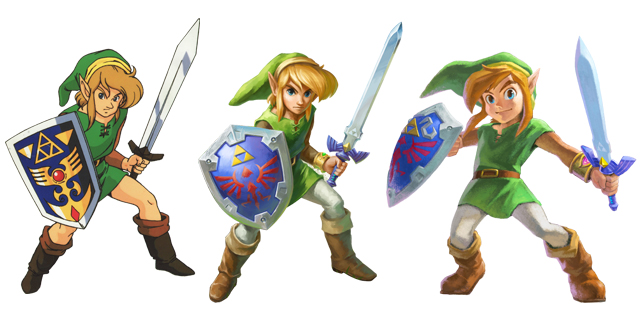
As for the environments, I rediscovered with great pleasure many graphic elements from ALTTP (obviously). Not really any new elements though, except
the Snowy Death Mountain, simply magnificent, with its Hinox in coats. I sense a strong inspiration from the Dark World of the hack The Legend of Zelda - Parallel Worlds, if you ask me!
So we have bushes, flowers (extra bushes near the cemetery), trees, the castle floor, caves, and many other locations visually very similar to ALTTP. But we didn't expect much more, knowing it would reuse so much from ALTTP. I will come back to the differences and similarities with ALTTP right after. Don't worry, I think this will be my last point :p.
Now for the music. It's rather uneven. Some tracks didn't catch my ear, while I absolutely loved others. Among the ones I didn't like, as I mentioned earlier in the review, is the very beginning of the game. The start is very similar to the start of TMC, though I think TMC's music was much better executed (and it was new!). That one is an old, lousy American countryside tune, which I didn't enjoy. Similarly, I've never really liked the Cocorico Village music in any game, so this version is no exception, but that's just my opinion.
But anyway, I prefer to focus on the tracks I actually enjoyed. One might think I loved all the remixes and hated all the new tracks. Not at all! I enjoyed almost every track in the game, and as I said, there are some I absolutely adored. Among them, there are new ones! Yes indeed! But since some tracks are only discovered later in the game, I will put this paragraph under a spoiler, so don't read it unless you've finished the game.
When leaving the Princess's house, you hear an orchestral theme very faithful to the SNES version, with a slight variation at the end of the melody. It's not super catchy, but I found it nonetheless superb! And especially, when you obtain Excalibur, DAT FUCKIN' ORCHESTRAL REMIX THAT ROCKS EVERYTHING! This is freaking energetic music, perfectly suited to the Zelda theme. Worthy of orchestral concerts like the one I saw in Paris last May ^^. In general, the remixes are excellently done. We have a good Hyrule Castle theme, a lovely Fairy Fountain theme, a nice Zelda theme, and a still-special theme for the Sanctuary :-). The castle music at the very start didn't appeal to me much, but later it's replaced by the real thunderous music of Hyrule Castle!
When arriving in Lorule, the Dark World music greets us with a sort of guitar. I like it because it's the Dark World, but the guitar doesn't really catch my ear. Then inevitably come the dungeon themes. I was worried for the first three, because the music, in my opinion, lulls more than it immerses. In ALTTP, regular cello strokes kept a steady rhythm in the music. Here, the music aims to be more impressive, thus slower, but I find it much less successful. On the other hand, I was pleasantly surprised in Lorule's various dungeons: each dungeon has ITS own music! Exactly what ALTTP was missing, and they fixed it—excellent! Moreover, each track revolves around a single theme, and is perfectly coherent within its dungeon. Hats off to the composers who did phenomenal work. And what about the FUCKIN' REORCHESTRATED DARK WORLD MUSIC by some insane genius? AWESOME. I love it. I stayed many minutes still in that Dark World just to listen. And the finale, Lorule Castle, progressive music, adding instruments every time a dungeon section is completed. A common technique, but still effective. I only discovered later that it was the inverted Hyrule Castle theme—again, hats off to the artists.
And finally, the final battle theme. All the nostalgia hit me when I heard the first notes of the final fight, identical to those of the last fight against Ganon in ALTTP. The ending credits music, however, is different, ending on a much happier note than in ALTTP where it was rather sad (which I actually liked). There are also new tracks: for example, I really enjoy the chicken minigame music and the racing game, or even the baseball minigame track, which, to complement the quirky atmosphere, sounds like a Wii Sports challenge. There is also the Lost Woods music, where you must take the right path to reach the Master Sword: it's mystical; I think nothing could describe this place better than this track ^^. Finally, I really like Big'Ornette's theme, especially when the choir kicks in as she upgrades one of our items, it sticks in my head, and just talking about it brings it back!!!*ndlr5
*ndlr5 : And just rereading this passage from my review 10 years later brings it back to me! 😁
In short, ALBW's soundtrack is one of its strong points, undeniably. Many tracks are orchestrally remixed, simply masterful. I doubt they used a real orchestra to record them; probably samples, but it doesn't matter—the music is high quality. There are some new tracks as well, most of which are worth hearing. Memorable music in a Zelda game, aside from a few in ST, hasn't been seen in a long time!
Now I move to my final point (hooray!): the relation with ALTTP. ALTTP is a game I know very well, as it's my favorite Zelda, and I have played it inside out and even more. This is also why I finished ALBW quite quickly while exploring: I already knew ALTTP's world very well, and ALBW's world is a remake. But an intelligent remake: the entire map was reused, yet many details were changed. As a result, locations are no longer accessible in the same way.
For example, the Desert only becomes accessible late in the game, whereas it was the second zone in ALTTP!
The location of dungeons also differs slightly. But I will say no more except under a spoiler tag:
The content of these same dungeons is very close to what we had in ALTTP. For example, the frozen statues that come out of walls in the Ice Ruins, slippery floors, hands falling on you in the Skeleton Forest, the girl to rescue in the Bandit Village Palace, etc. Only the Swamp of Suffering is not reproduced, and the Wind Mansion is a dungeon with a completely new theme compared to ALTTP.
A slight disappointment with Lorule Castle nonetheless: it pales compared to ALTTP's ultimate Ganon Tower.
As for the bestiary, it is very similar to ALTTP, which was expected.
Thus, most bosses are reused, even though there are quite a few new ones. Enemies are almost all the same, though some deal different damage. In fact, we find nearly all of them, including the Spike Rollers, those spiked bars that roll on you. However, there are no Chain Chomps from Mario. But broadly speaking, except for a few exceptions, all ALTTP enemies reappear in ALBW. I think hard and I see no real bestiary novelties except snow Hinox or some mini-bosses.
Finally, the atmosphere. I've already covered this, so I'll make a brief summary: ALTTP's atmosphere is perfectly conveyed through ALBW in several ways I've discussed throughout this review. It's quite funny, because if ALTTP was like this (little narration, characters we don't see again in the series, etc.), it was because at the time there were technical limitations due to the console (and with a console that can run OOT, I doubt technical limits are significant :p), but also because it was the third installment, after Zelda 1 and Zelda 2 which added little in terms of story or universe. ALTTP is the foundation, the pillar of the entire series, as all subsequent games drew inspiration from it, in gameplay, story, or narrative form. But at ALTTP's time, the series was still finding itself to expand in later games, notably OOT, further consolidated by later entries. That's why the witch wasn't yet named Syrup, for example. That's why we never saw Agahnim or Sahasrahla again. That's why the Gorons didn't yet exist and the Zoras weren't the peaceful people we know today, since OOT. That's why the mountain was really called 'Hebra Mountain' and not 'Death Mountain,' a name only valid for the Dark World. ALBW covers almost 15 years of legend to focus solely on its predecessor. One could almost call this a risk from Nintendo towards fans who discovered Zelda with Ocarina of Time or Twilight Princess and swear only by them. And just this gesture, I find beautiful.
So, I think I can now conclude this post; I started writing it at 11:40 this morning, and despite multiple breaks, I finish it a little after 8 PM. In conclusion, what to say? I'll draw a parallel with TWW and its successors. It's true: PH is one of the Zeldas, if not the least appreciated in the series (though there's the eternally underrated FSA…). Yet it is very innovative in terms of gameplay! That's because the majority judged it against The Wind Waker. Soon after came Spirit Tracks, a game I personally loved. Yet people hated it. Why? Because it was PH's sequel, the unworthy follow-up to TWW. But TWW is nothing compared to this pillar that is ALTTP. So making a 'sequel' or a 'remake' (call it what you want) of this monument was almost suicide. Yet it's a complete success. The atmosphere is perfectly conveyed, whether in gameplay, characters, mini-games, environment, exploration, dungeons, or music—we are immersed in this universe, and for me, that's Zelda.
A Link Between Worlds is a great game, a worthy descendant of A Link to the Past.