Manga / Comics
To date, there are various manga / comics concerning ALTTP. Here, in order of appearance, is the complete list of books related to the games currently known:
- The Legend of Zelda - A Link to the Past, comics by Shotaro Ishinomori (1992-1993-2015)
- Zelda no Densetsu - Kamigami no Triforce, manga by Junko Taguchi (1993)
- Zelda no Densetsu - Kamigami no Triforce, three-volume manga by Ataru Cagiva (1995-1996)
- The Legend of Zelda - A Link to the Past, manga by Akira Himekawa (2005-2009-2010)
It should be noted that the first episode of an animated series was released, created by amateurs under the name Zeldamotion. It is based on the beginning of Akira Himekawa's manga (which itself is based on the 1992 comic!).
Some of the manga / comics listed above are translated, either in English or French, as fan-translations or official translations, and others have remained in Japanese. In any case, if they are available to us today, it's thanks to the colossal work of the person behind the "History of Hyrule" project, who presents herself as an archivist of everything related to Zelda, and thanks to whom we have access to an incredible number of high-quality scans of old magazines / manga / books of all kinds today. I highly recommend following her on Twitter because without her, half of what we know about Zelda would still be in the dark.
Personally, I have read all the aforementioned manga, regardless of the language in which they exist. The purpose of this page is therefore to provide a presentation of each of them, sometimes a slightly more detailed description, as well as my opinion. It should be noted that I read them years ago, so the "My opinion" paragraphs reflect what I thought when reading them at the time, roughly between 2013 and 2016.
Shotaro Ishinomori's Comic (1992-1993-2015)
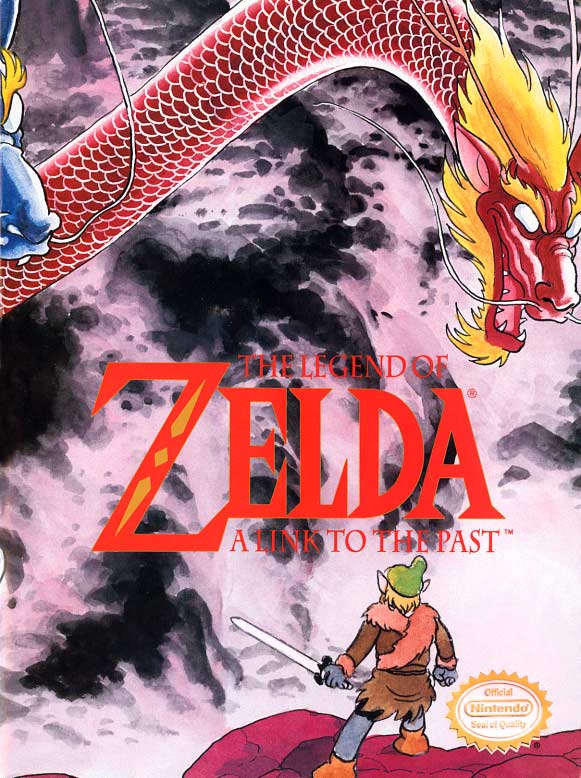
The comic first appeared in 12 chapters, published monthly from January 1992 to December 1992, in the American magazine Nintendo Power (in the USA*). Then, the following year, in 1993, the 12 volumes were collected into a single work released in the USA, then in Japan. You can read the 12 original chapters at this address.
* There was also a Japanese "Nintendo Power" magazine back in the days.
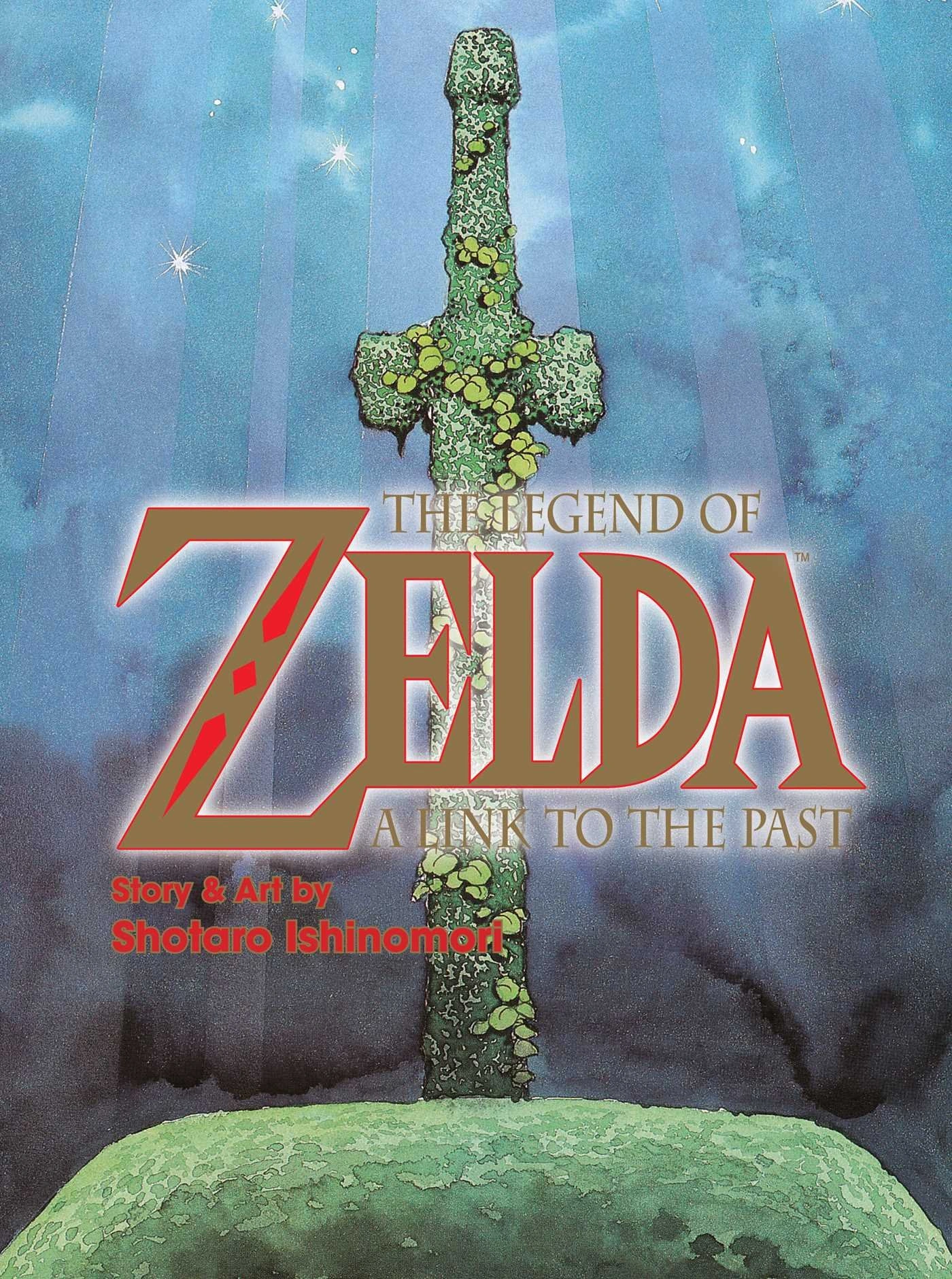
More recently, in May 2015, the comic was re-released as part of a new edition, and this time translated into other languages ! It also boasts a brand new cover, as for the content, it's the same to my knowledge. Enjoy the cover below:
On the very last page of the re-edition, we find what appears to be a retrospective on this work by its artist Shotaro Ishinomori (石ノ森 章太郎), who states that it was a real challenge for him to have to write these 16 monthly pages, all in color, mainly because he was addressing a non-Japanese audience. Many gags apparently could not be integrated into the comic due to American puritanism, and he therefore had to fight with editors and constantly adapt in order to publish it. Despite all these trials, he remains proud of his work.
Below is the list of chapters (this time we'll indulge and use the French titles 😄) as well as a summary of each of them.
Chapter 1 - The Hero's Awakening
Link, a young man living with his uncle in Hyrule, is called by a voice in his sleep. The voice claims to be trapped in the castle. Link then opens his eyes and sees his uncle's empty bed. He decides to go to Hyrule Castle, where he finds his uncle, who is defeated in battle by a masked man named Agahnim. His uncle then asks him to go save Princess Zelda, telling him he is her last hope. Link complies and manages to flee with Zelda through the sewers, finding refuge with an old man. Zelda senses that Link is the legendary hero who appears every hundred years, but doesn't have time to tell him more, as Agahnim finds her and kidnaps her again. Link will therefore embark on a quest to find the Master Sword in order to defeat Agahnim...
Chapter 2 - The Sage's Warning
Initially, Link will flee from soldiers as he is actively sought throughout the country, with a bounty on his head. He will meet an old man who tells him to go see the sage Sahasrahla. Subsequently, Link will be saved by a little boy, with whom he will become friends, and who will explain where Sahasrahla lives. Link will overcome many dangers to reach the Eastern Palace, where the old man resides. The old man will bestow upon him the Pendant of Courage, thanks to which he will overcome Agahnim's men who managed to find him.
Chapter 3 - The Book of Mudora
Link returns to Kakariko Village and saves the librarian from his burning library. The latter gives him the Book of Mudora, through which Link can uncover the secrets of the desert. The child Link had previously met gives him mechanical wings so Link can reach the desert. There, he fights a Lanmola and obtains the Pendant of Power.
Chapter 4 - The Legendary Sword
Link crosses the arid desert and climbs along Death Mountain, until he reaches Hera's Tower. There he confronts Moldorm, a giant spider (???), and obtains the last pendant. Afterward, he goes to the Lost Woods to find the Master Sword.
Chapter 5 - An Old Enemy
Link, armed with the Master Sword, wants to find Agahnim. But Hyrule Castle is too well guarded. He then calls upon his friends from Kakariko Village, who build him a hot air balloon so he can reach the top of the Castle tower. Indeed, it is here that Agahnim performs the ritual by sending Princess Zelda into the Dark World. Link arrives just in time, but Agahnim immobilizes him and still manages to send Zelda to the other world. A fight to the death ensues.
Chapter 6 - In the Shadow of the Sinful Tree
Link manages to defeat Agahnim, but he hasn't said his last word and also sends Link to the Dark World! Link then tries to find rest and discovers the home of a tree, which confesses to having been searching for the Triforce before being transformed into a tree by the Dark World. The tree speaks to Link about Ganondorf - or Ganon, for the first time. Link, upon leaving the tree's home, is confronted by monsters chasing a small fairy, whom he defeats without much trouble.
Chapter 7 - The Zora Mask
Accompanied by the fairy Epheremelda, Link meets Zora, who gives him a mask making him resemble a monster and advises him to go to the Palace of Darkness. Link complies and there finds one of the seven abducted maidens. He also blows up the Palace of Darkness. At the end of the chapter, he meets a soldier asking him to hand over the Master Sword.
Chapter 8 - Roam, the Mysterious Mercenary
The soldier, named Roam, is a descendant of the Knights of Hyrule, just like Link. However, his specialty is the crossbow. He then transforms into a raptor thanks to the power of the Dark World to attack Link, claiming to be the Legendary Hero, but Link subdues him. After that, Link can communicate with Sahasrahla, who remained in the Light World, and who tells him that according to his indications, the Dark World is very similar to the Light World. Link then heads towards the completely dried-up Swamp Palace. At the same spot, Sahasrahla and Link's friends see a well filled with water. Monsters then attack Link, but his friends activate a faucet in the Light World, which fills the well in the Dark World where Link is located.
Chapter 9 - The Wizzrobe Trap
The enemies who had attacked Link drown, and he can access, thanks to the water level, a passage leading to a waterfall. Then, a kind of giant octopus attacks him, but he still manages to defeat it, freeing another young girl. Afterward, he ventures into a mire and sees the Princess held by vines. As he approaches to save her, he realizes it was actually a disguised wizard who set a trap for him: Link then finds himself trapped in the vines, at the mercy of Vitreous, a large pile of giant eyes. But then, he is saved in extremis by Zora, who drowns the eyes and the wizard, thanks to his power.
Chapter 10 - Turtle Rock and... Zelda!
Link learns that Zelda is imprisoned in a rock resembling a turtle. But to reach her, he will need a plan. That's why he first goes to the Ice Tower. Defeating two Stalfos Knights, he can read the map which turns out to be the floor of the Ice Tower. He then succeeds in reaching Turtle Rock, where Zelda is indeed imprisoned, but is then confronted by a three-headed dragon above the lava. Roam comes to his rescue.
Chapter 11 - Ganon's Palace
After blowing up Turtle Rock, Roam, Link, and Zelda head to Ganon's Tower. Roam goes there thanks to his transformation into a raptor, while Zelda calls upon the power of the seven sages to allow Link and her to reach the Tower. Link sees the ghosts of several bosses he has already faced, notably Agahnim. It is Roam who takes charge of defeating the ghost of the latter. But then, Ganon's body emerges from this ghost.
Chapter 12 - The Final Battle
Link fights Ganon, but is quickly overpowered. Then, Zelda creates a diversion, Link reaches Ganon with his sword, immobilizing him. Zelda, using Roam's crossbow and the power of the sages, fires a silver arrow at Ganon, who explodes and releases the Triforce as he dies. She asks Link to touch it and make a wish. Link, Zelda, Roam, and all the Hylians imprisoned in the Dark World return to Hyrule, while the dark world is destroyed. Link is named Master of the Knights of Hyrule by the Princess, and eventually rests the Master Sword on its pedestal. Zelda comes to see him and tells him she regrets that he is so distant when their spirits were once connected. The comic ends with a view of the century-old sword, awaiting its next hero.
Before moving on to the next manga, here's my (old) opinion on Shotaro Ishinomori's comic:
I read this comic after reading Akira Himekawa's manga, and it's so much better! First, the colors on the pages really help with enjoyment. The action is much more readable. The characters, however, are not always very well drawn, finished with a few pencil strokes, but you still understand who is who.
As for the story, it's pretty well adapted. A few elements were skipped, among others the passage through the Outlaw's Village as well as the Skull Forest. Otherwise, everything is there with a fairly accurate fidelity, which I really appreciated: the fact that the Wizzrobe is in the Misery Mire (that's where it first appears in the game), the three-headed dragon of Turtle Rock which directly references Trinexx, the way to open Turtle Rock as well... They even included the suspended bridge that connects Turtle Rock to Ganon's Tower in the Dark World, which I greatly appreciated.
Afterwards, the addition of extra characters, like the kid from Kakariko, the fairy Ephremelda, or even Roam, didn't bother me. Each of them isn't omnipresent, so it works well. The other changes help to get into the comic, because let's be honest, if you were to tell the game with exact fidelity, the comic would be boring, even though the game is fun. It's not the same format, you know. But the differences with the game are generally well-introduced, the action is, I think, well-controlled, the fights are dynamic without overdoing it (although some bosses are completely rushed, like Moldorm, for example).
Finally, a small remark to say that some elements were created through this comic even though they didn't yet exist in the game: the fact that a fairy accompanies Link, which we would only see 6 years later in OOT, or the fact that Link has to wear a Zora mask, even if it won't look like that in OOT and MM. Perhaps this comic directly inspired some elements of the following games, but we'll never know 😉.
In short, it was a very enjoyable comic to read, and I recommend it if you like the game!
Junko Taguchi's Manga (1993)
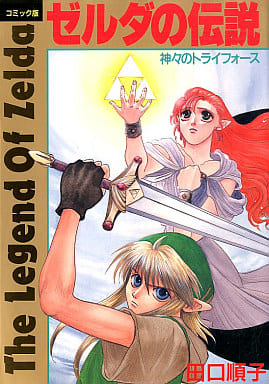
This manga is only in Japanese; I haven't found a fan translation, even in English. Overall, there's very little information on the Internet about this manga, and also about its author. The manga is very long (almost 200 pages!), and I recall the beginning was really comprehensive, taking several pages to tell us how Ganondorf came to touch the Triforce (cf. synopsis), which isn't present in other works.
I had read this manga without detailing it in the first version of the document, and today I remember very little of it, except that the dungeons seemed completely rushed, but the story sequences were very extensive. This will require a complete re-read to properly construct this paragraph. So, no chapter breakdown and no opinion!
Ataru Cagiva's Three-Volume Manga (1995-1996)
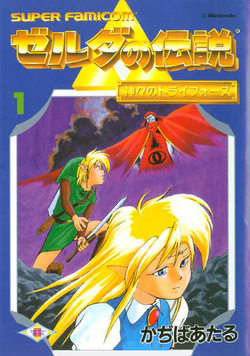
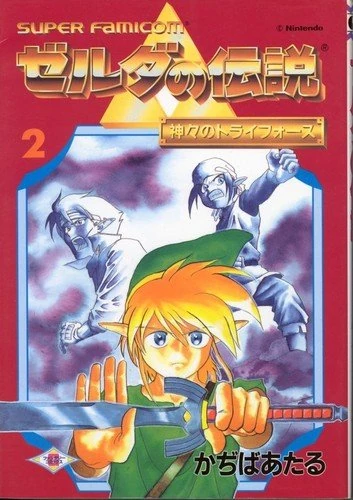
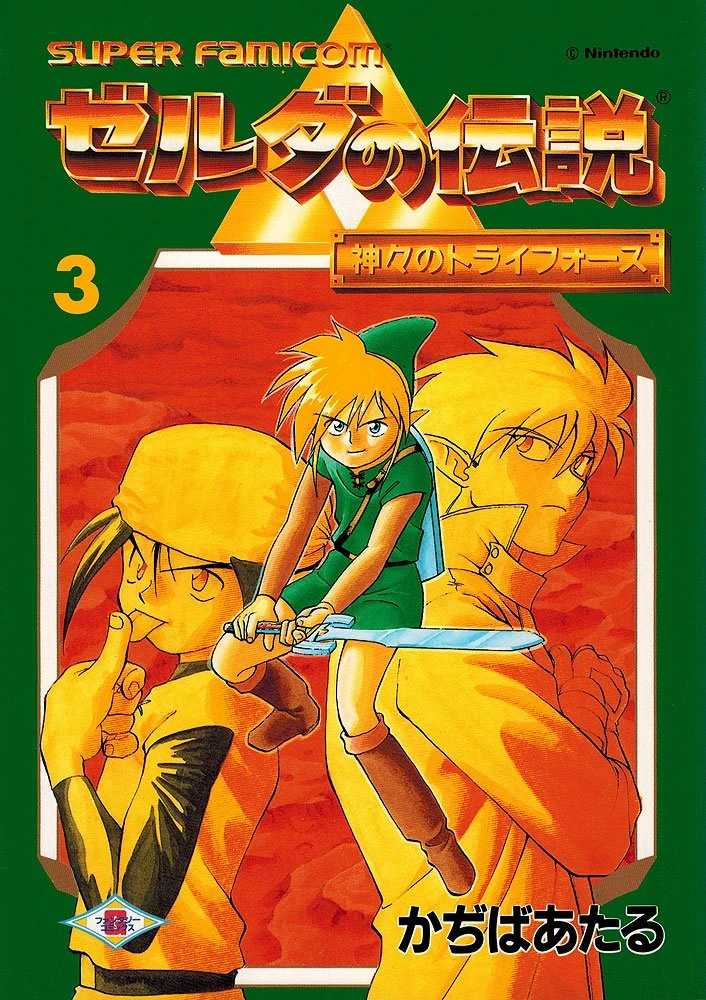
The first two volumes appeared in June and December 1995. The third and final volume was published in May 1996. They have never been officially translated, but an English fan-translation exists, which is the version I read at the time, as my Japanese level was not sufficient. The collection was published in the monthly magazine "Gekkan G Fantasy" (月刊Gファンタジー), and it is the second work by manga artist Ataru Cagiva (かぢばあたる). He had previously drawn a 2-volume manga of Link's Awakening (yes, he first did Link's Awakening, then A Link to the Past!).
The manga is divided into three volumes, each containing just under 200 pages. Consequently, as you might expect, the story had the opportunity to be quite well developed. Furthermore, many dramatic elements were added to adapt the game to the manga format, while trying to remain as faithful as possible. For example, to allow for dialogue, Link was given two companions who accompany him almost throughout the adventure: Rahska (or Rasuka, or even Raska), a childhood friend of Link, as well as the Captain of the Knights of Hyrule (he has a name, but is always called "Captain"). He is a friend of Link's uncle.
Thus, the story is divided into 18 chapters spread across the three volumes. The first volume deals with the Light World, while the other two recount the heroes' adventures in the Dark World. Here is the list of the 18 chapters - without summaries, however, and with English titles (since I had read an English fan-translation). I don't know why I didn't write chapter summaries at the time, and today I absolutely don't remember this manga. When I find the motivation to dive back into these three volumes, I will try to do this work!
- Volume 1
-
- Chapter 1: The Priest Agahnim
- Chapter 2: Princess Zelda
- Chapter 3: Escape
- Chapter 4: Setting Off
- Chapter 5: The Heart of a Hero
- Chapter 6: The Master Sword
- Volume 2
-
- Chapter 7: Confrontation
- Chapter 8: The Dark World
- Chapter 9: Kanika
- Chapter 10: The Crystal Seal
- Chapter 11: The Trap
- Chapter 12: Rupture
- Volume 3
-
- Chapter 13: The Light of the Blade
- Chapter 14: The Return
- Chapter 15: Betrayal
- Chapter 16: Destiny
- Chapter 17: Struggle to the death!
- Chapter 18: A New Journey
I mentioned earlier the English fan-translation I had read at the time; it is available on the historyofhyrule.com website (where you can find all this precious information about these old, obscure manga!). Below are the links to the fan-translations of the different volumes:
Well, as someone who is generally a bit reluctant to read manga, I really enjoyed this one 😀. It is generally quite faithful regarding the dungeons and their bestiary. However, don't expect too much, because just like the comic, we won't see all the dungeons, nor all the bosses. But we will see most of them. The fidelity to the game doesn't stop at the dungeons, and we'll see many details and many story elements taken directly from the game; for example, Zelda being kidnapped not before, but after collecting the three Pendants. Likewise, we have an Agahnim who, at the very beginning of the story, is a generous priest in the king's service, and it is only afterwards that he reveals his true nature, as explained in the game manual. These kinds of details are very pleasing.
But well, this manga isn't 100% faithful to the game either! As I told you, we have the addition of two main characters besides Link: Rahska and the Captain. These two will accompany Link everywhere, even in the Dark World. Consequently, there will be no story of Moon Pearl and animal versions of oneself in the Dark World, so that everyone remains human. They will later meet Kanika in the adventure, a rather interesting character. It might be shocking that Link is accompanied, but frankly, it's well done and you get used to it. And besides, the characters have time, thanks to the 3x ~200 pages, to be more developed than in other books, so that's pretty cool too.
But (because there's always a "but" 😛), as much as the characters are more developed than in other works, it doesn't reach great heights either. For example, in the first volume, Rahska and Link engage in a petty war up to Moldorm to see who kills the most enemies. This completely breaks the immersion, which is quite a shame. Furthermore, there are many lengthy passages (especially in volumes 2 and 3); the characters constantly question themselves, ask existential questions, and ponder the meaning of life. And above all, the POWER OF FRIENDSHIP. Oh yes, you'll get a taste of the power of friendship, and the power of love! A big cliché of Japanese entertainment, this manga is no exception to the rule, and it's a real shame, because we could well do without certain scenes.
But still, the story is well-paced, the drawings are generally good, the action phases are legible (which Akira Himekawa's manga sorely lacks), the characters are pretty cool, and even if the story follows the game's plot and is conventional most of the time, there are quite a few differences that sometimes make it slightly unpredictable, and you always want to read more.
In short, a good manga that I recommend, whether you've played ALTTP or not 😉.
Akira Himekawa's Manga (2005-2009-2010)
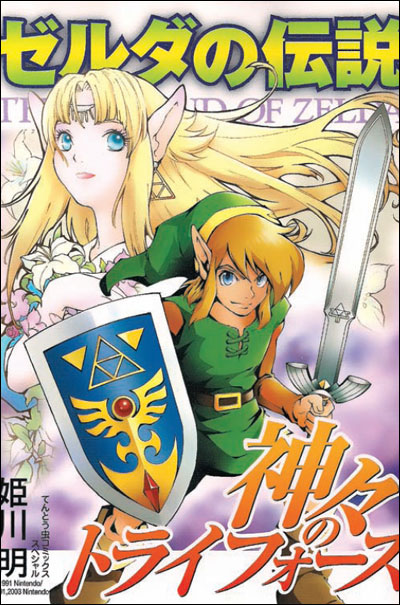
By far the most famous manga, it was released in July 2005 in Japan and reissued in French in July 2009 by Soleil editions, as well as in English in February 2010 by Viz editions. Like other manga, it is based on the game, but modifies and adds some elements to adapt to the shonen format. The biggest addition is the character of Ganty, a young thief who helps Link in his quest. Many elements are also shortened or even removed, making it a rather short manga that gets straight to the point. Indeed, there are four chapters:
- Prologue
- Act 1: The Voice
- Act 2: A Legend
- Act 3: Sacrifice
- Act 4: A Link to the Past
Rubbish 😛. Just rubbish. It's basic shonen. The characters are very underdeveloped, everything is conventional, no surprises. I get the impression that the character of Ganty is there to add an extra pair of boobs, and to create a kind of romantic ambiguity between the three main characters (Link, Zelda, Ganty). Here, no Moon Pearl anymore, anyone can wander in the Dark World and live a peaceful life (whereas originally it was Ganon who transformed the Sacred Realm into a hostile world, you know).
However, we can commend the fidelity of the legend, recounted in the game manual, and transcribed here. We also see different artworks redrawn by the author, which is always a pleasure.
Finally, often during battles, the action is rather illegible, and the author clearly felt this, as there are ultimately few battles, and when there are, there are few fighting scenes. For example, when Link arrives at Hera's Tower, you see Moldorm on a panel (which, by the way, resembles Skorn from Majora's Mask), but you don't see a fight, just Link taking the pendant and leaving.
Finally, the Dark World is rushed through at a rather impressive speed. To such an extent that 4 or 5 dungeons are listed in a single bubble (no image, of course), and Link goes directly to Turtle Rock. Needless to say, we don't see much of Turtle Rock or Ganon's Tower either; endless dialogues with Agahnim and Ganon are preferred.
After reading Shotaro Ishinomori's comic, I realize that many elements of this manga were borrowed... But most of them are worse. The classy but discreet character that was Roam is here transformed into Ganty, a rather heavy character. Link's uncle dies in the same way at the beginning. In both comics, Zelda is kidnapped not after recovering the three medallions, but before, and the journey through the Dark World is similar, except that it is not confined to a single bubble in Ishinomori's comic. In short, the latter is superior to Akira Himekawa's manga in every way.
As you will have understood, this manga is a very disappointing read for anyone who has played the game. Only read it if you have time to waste... Instead, I recommend the comic, which is well worth a look.
The Zeldamotion Fan Anime
As I mentioned in the introduction to this page, an animated short film was released on YouTube, produced by Aeipathy Industries. This short film constitutes Episode 1 of a series that was intended to fully adapt Akira Himekawa's manga. Here is the video:
For the record, the creators of this animation, seeing the success it generated, launched a Kickstarter campaign to raise funds for subsequent episodes. They asked for $24,000 for an additional episode, and even went as far as asking for $298,000 for the entire series! But let's not panic: faced with the impending legal issues with Nintendo (and, as we all know, they are not a big fan of this kind of project), they ultimately canceled their Kickstarter, even though they had managed to raise $6,355.
It's amateur animation, and it shows. That said, it's rather well done for an amateur production, because 8 minutes requires colossal work. Afterwards, there are things to criticize, such as even choppier animation than a classic anime, a global realization quite similar to a flash video (I wonder if it wasn't one originally, by the way), and thus of poor quality. As for the acting, it's passable, but not trash as I've read here and there.
Furthermore, basing it on Himekawa's manga, which is the worst piece of work (by far) dealing with ALTTP, is not a good idea in my opinion. I refer you to the paragraph My opinion concerning the said manga a little further up.
Finally, I'm quite glad this Kickstarter campaign didn't succeed. It might be mean of me, but honestly, asking for $24,000 for one episode, I think it's a scam. What they made is far away from being worth $24,000. So yes, one can suspect it would have been of better quality, but in that case, it would have clashed with this first episode (unless they redid it later). That said, I remain convinced that they could have done a very good thing without reaching such an astronomical sum. As for $298,000, that's a big joke. And then, hello Nintendo lawyers.
Let's end this review on a good note, because I still salute the initiative of wanting to animate A Link to the Past, a Zelda little recognized compared to the 3D episodes. They could have chosen Ocarina of Time or Twilight Princess, more "hyped" Zeldas, which would have attracted many more people, but they chose the Zelda of the heart instead. And for that alone, hats off.